HubSpot, AI and the end of traffic as truth
Why HubSpot’s rename matters
HubSpot’s decision to retire the INBOUND brand in favour of UNBOUND is more than marketing theatre. The company says the rename reflects a new era in how businesses win customers, and the shift is being read across the industry as an admission that discovery is changing fast. (hubspot.com)
The zero-click reality
Recent industry research shows what that admission looks like in cold numbers. Analysis of large clickstream data indicates that roughly six in ten Google searches now finish without a click to the open web. That pattern has only been amplified by the arrival of AI overviews and LLM-based assistants which often answer questions inside the interface. For search-dependent businesses this is an existential change to the signal that once drove content strategy. (sparktoro.com)
Why organic visits have lost context
Traffic figures were useful when a high volume of top-of-funnel browsing reliably fed downstream leads. Today, however, volume can be misleading. A site that sheds low-value glossary pages and doubles down on conversion-ready pages may see overall visits fall while revenue rises. The hard lesson for marketers is that a raw visits number is a poor proxy for intent or return on investment. (searchengineland.com)
Where real organic value now sits
If you accept that discovery increasingly happens inside LLMs and other zero-click surfaces, the pages you should be measuring change too. The recent analysis identifies four page types that matter most for business outcomes: homepages, pricing pages, product and solutions pages, and what the author calls money-content pages such as demo landing pages or original research. These are the locations where buyer intent clarifies and commercial decisions are made. (searchengineland.com)
A new reporting playbook for SEO
The old playbook of query-level rank tracking and aggregate organic traffic needs to be retired as primary evidence of success. Two structural changes should be non-negotiable in dashboards going forward:
-
Page-level health and trend reporting. Focus on the performance of high-intent landing pages rather than volatile keyword positions. This produces a cleaner line of sight from content to outcomes. (searchengineland.com)
-
Branded search as a proxy for AI visibility. Because many users respond to LLM recommendations by searching a brand directly rather than clicking a citation, rises in branded search volume can indicate off-site AI influence. Where possible, capture this signal and correlate it with lead and pipeline metrics. (searchengineland.com)
Accountability, not vanity
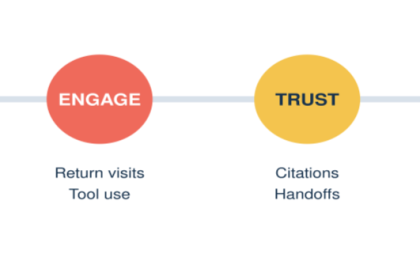
Executives will not accept nebulous assurances. The smartest teams are shifting to a mix of input metrics they can control and lagging indicators that actually reflect business impact. Inputs include topical coverage breadth, coherent topic clusters connected by internal linking, distribution velocity across channels, and a cadence of updates for cornerstone commercial pages. Lagging indicators should emphasise branded clicks, self-reported attribution in high-intent forms (for example an explicit “AI search” option), and verified mentions in trusted third-party lists and analyst reports. (searchengineland.com)
How this plays out in the funnel
A modern B2B purchase typically unfolds in three acts. First, the discovery layer is often an LLM where the shortlist is formed. Second, prospective buyers use traditional search and reviews to verify claims. Finally, conversions occur on a pricing or demo page once the buyer has validated a shortlist. That dark funnel in the middle is largely invisible to classic analytics, which is precisely why reporting needs to pivot to proxies and page-level outcomes. (searchengineland.com)
Practical steps for Irish and UK firms
For firms that still prize accountability and margins, the implications are practical and immediate. Start by auditing your content inventory and segment pages by intent. Build dashboards that show visits and conversions for the four high-intent page types and add a branded-search trend line. Introduce a short-form attribution question on demo and pricing forms that includes AI / ChatGPT / LLM as an option. Finally, stop rewarding sheer output; reward measurable progress on the inputs that drive conversions. (searchengineland.com)
A final, uncomfortable point
This is not an argument to abandon organic presence. It is an argument to stop pretending that yesterday’s vanity metrics are evidence of value today. Firms that continue to measure success by total visits are already budgeting for irrelevance. The more conservative, ROI-focused approach is to concentrate resources on the pages and signals that actually move buyers to the register, and to show the C-suite how those signals translate into pipeline. For anyone who still treats traffic as truth, HubSpot’s rename is your call to re-evaluate. (hubspot.com)
Credits and sources
This piece draws on reporting and analysis published by Gaetano DiNardi at Search Engine Land. For the underlying zero-click data, see SparkToro’s zero-click studies. (searchengineland.com)
Related Posts
- Prepare to Choose Sides in the Major IPO Showdown Among Tech Giants
- OpenAI Seeks CMO to Supercharge Its Ads Business
- Lawmakers Condemn Republican AI-Generated Attack Ad Targeting Supervisorial Candidate Ricardo Valencia
- Uber Confirms Takeover Bid for Delivery Hero: What This Means for the Future of Food Delivery
- OpenAI Expands Ads Manager Beta With Advanced Budgeting and Geo‑Targeting Controls